A Quiet Evening of Moon Watching
Moon watching turns an ordinary evening into a closer look at the Moon’s position, changing light, and surrounding sky, with a simple way to record what you notice.
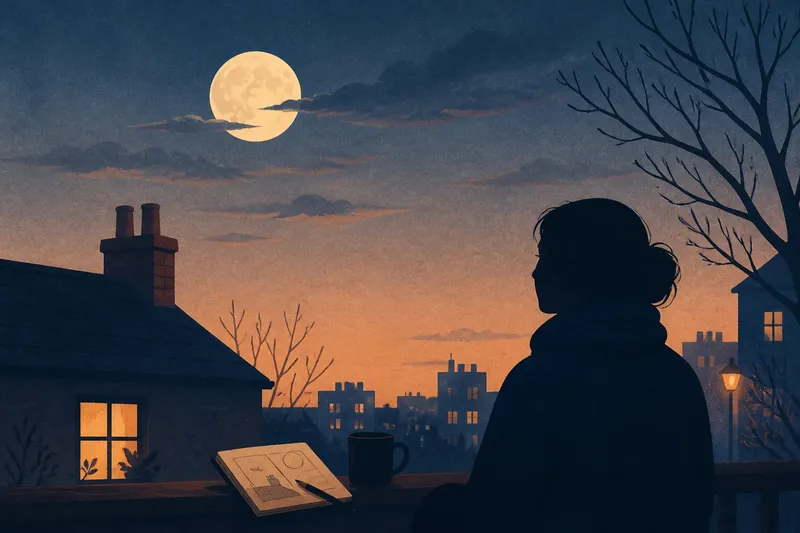
Moon watching can start on a front step, with the Moon just above a chimney and a bright window competing for your attention. You do not need to identify lunar features; the useful question is how the Moon and the rest of the view change as you keep looking.
Choose one comfortable place and return your attention to the same patch of sky during the evening. The Moon is a steady reference, while clouds, fading light, and the outlines of nearby buildings alter the scene. A few deliberate observations are enough to make an ordinary view feel particular.
Where should you watch the Moon?
Look for a spot with an open view of the sky and a fixed foreground shape: a roof corner, bare branch, chimney, or distant hill. A porch, balcony, courtyard, or park bench can work. The foreground gives your eye a reference, not a measuring instrument.
Before settling in, check whether the Moon will be visible from that spot at the time you have available. A sky app or local forecast can help with timing and clouds, though a gap in the weather is never a formal appointment. If your usual view is blocked, move to a safe, familiar place with a wider horizon.
Bring a warm layer if needed and keep the path back indoors clear. For this kind of Moon watching, the unaided view helps you notice the horizon and surroundings as well as the Moon. Binoculars and telescopes can wait for another sort of evening.
What should you notice as the sky changes?
Begin with the whole scene rather than staring only at the Moon. Notice its position relative to the fixed foreground, the color of the remaining daylight, and whether thin clouds are visible elsewhere in the sky.
After a pause, look at the Moon’s outline. Is it round, a bright curve, or softened by cloud? Then look away briefly and return. As the sky darkens, the contrast between the Moon and its surroundings changes; foreground details may become silhouettes while the Moon’s edge remains easy to follow.
Later, compare the Moon’s position with the same roofline or branch. It may appear to have shifted across the sky. You need not estimate a distance or keep checking the clock. The comparison is enough to make the movement legible.
If clouds cover the Moon, watch their edges and the changing brightness of the patch of sky where it was. A view does not become useless merely because its main subject has taken a brief leave.
What can the foreground and horizon tell you?
The Moon gives the eye a bright anchor, but the surrounding view supplies the composition. A thin cloud crossing the Moon can be easier to follow against its bright edge. A nearby tree or roof makes changes in apparent position easier to notice. As twilight fades, the same objects lose detail and become silhouettes.
The horizon matters, too. Haze or cloud can soften the Moon’s outline, while a streetlamp or reflective window can pull attention away from it. If you move a few steps to clear an obstruction, notice how the frame changes: a branch may enter view, or a building may hide part of the horizon. Your position is part of what you see.
Say you begin on a balcony with the Moon above a neighboring roof, a phone in your pocket, and a thin cloud approaching from the side. You first note the Moon’s position against the roof, then wait while the cloud crosses and compare the scene again. The resulting observation is specific: the cloud softened the Moon’s edge, and the roof remained a useful reference. Nothing needs to be identified beyond that.
How can you keep a brief record?
A note, sketch, or photograph can help you recall the arrangement, but none is required. Keep the record focused on what changed rather than trying to produce a polished account.
- Check the foreground: If a roof, branch, or hill is clearly visible, use it as the reference for your next glance; if nothing fixed is in view, choose another angle or simply describe the Moon’s position in the open sky.
- Check the cloud cover: If a cloud crosses the Moon, note how its edge or brightness changes; if clouds hide it completely, watch the gaps or return to the view later.
- Check the horizon: If haze or nearby lights obscure the view, shift to a safe spot with a clearer sightline; if moving is impractical, record the obstruction as part of the scene.
- Check the changing light: If the foreground becomes a silhouette, compare its outline with your earlier view; if the sky stays bright, continue noticing clouds and the Moon’s relation to nearby shapes.
- Check whether a record helps: If a short note would help you remember the composition, write one plain sentence; if writing interrupts your attention, leave the phone or notebook aside.
- Check a photograph before relying on it: If the Moon and a foreground shape both appear clearly on screen, keep the image as a reminder; if the Moon becomes a bright speck or the sky looks noisy, use a note or sketch instead.
For instance, imagine you have a phone, a pencil, and a view of the Moon beside a chimney. You notice a cloud soften the Moon’s edge, then find that a phone picture renders the Moon as a small bright dot with little context. You put the phone away and write, “Moon beside chimney; cloud softened lower edge.” The tradeoff is clear: the photograph preserves a frame, while the note preserves the detail you cared about.
What do people ask about Moon watching?
Can you watch the Moon from a city?
Yes. Buildings and streetlights may limit the view, but a courtyard, balcony, or gap between buildings can frame the Moon. Use a safe, familiar place rather than seeking a perfect horizon.
What if clouds cover the Moon?
Watch the clouds and the patch of sky where the Moon disappeared, or wait for a gap if the weather is changing. The shifting brightness can still give you something concrete to notice.
Do you need to know the Moon’s phase?
No. Knowing whether the Moon is full or crescent-shaped can add context, but you can describe its visible outline without naming a phase. Direct observation is enough for a quiet evening.
Is a photograph necessary?
No. A short note or simple sketch may preserve the relationship between the Moon and a nearby shape better than a phone image. Looking without recording anything is also a complete choice.
When is a good time to stop?
Stop when you are ready, not when you have completed a set of observations. Before going inside, look once more at the Moon and the foreground together. Notice whether your attention now goes first to the Moon, a passing cloud, or the roof that made its position easier to follow.
Moon watching is easy to return to because the useful details are ordinary and local. If a branch or building gave you a clear reference, remember where you stood; the next evening’s view will have its own arrangement.