Before the Telescope, People Mapped the Sky by Memory
How people mapped the sky by memory: learn how star patterns made shared observations easier to recognize, describe, and pass between generations.
Before a telescope could bring faint stars into view, people mapped the sky by memory, using bright stars, recurring shapes, and familiar directions as landmarks. A remembered pattern made it possible to point out the same patch of darkness to someone else, even when neither person had a written chart.
How did people find patterns among the stars?
They noticed which stars appeared near one another and imagined lines, figures, or objects connecting them. The stars supplied the visible points; the connecting shape came from human attention. A bent row might suggest a hook, while a compact cluster could be remembered as a handful of sparks.
This was not simply a matter of spotting pictures. A pattern could be useful because it stood out from nearby stars, because its orientation was easy to remember, or because it appeared in a familiar part of the sky. People selected a few points as anchors and treated the less distinctive stars around them as supporting details.
The process resembles remembering a route by its turns rather than memorizing every stone beside the road. A recognizable grouping reduced a crowded sky to a manageable set of landmarks. Once a person knew the shape, they could look for it again and use it to locate neighboring stars.
Why were shared star patterns useful?
Shared patterns gave people a common way to refer to what they saw. Instead of describing a star as “the bright one above those other bright ones,” a speaker could name a familiar figure or describe a star’s position within it. The words depended on a community’s conventions, but the visible arrangement gave the conversation something to point toward.
A shared map also helped with teaching. Someone who knew a pattern could show another observer its anchor stars, trace the imagined connections, and explain how to recognize the shape when it appeared again. The learner did not have to inherit a drawing; they could learn the sequence of visual cues directly under the sky.
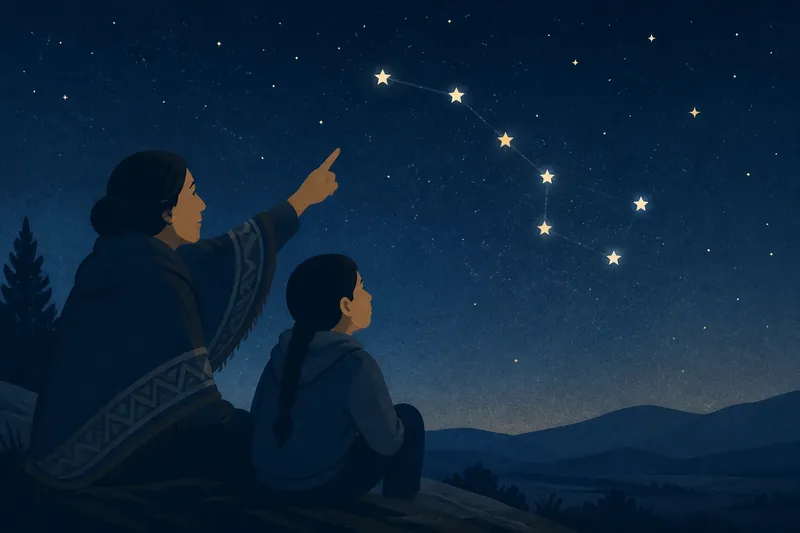
Imagine a family standing outside after dusk, with one person trying to show a child a crooked row of bright stars. The adult first points out the row’s brightest end, then traces the bend with a finger and names the shape the family uses for it. On another evening, the child can look for that same bend and recognize the group without being told where to start. The expected result is not a perfect picture, but a shared reference that makes a later conversation easier.
Did everyone see the same constellations?
No. Star patterns are interpretations, not lines physically drawn across the sky. Different communities could connect the same stars in different ways, give a familiar grouping different names, or emphasize a different part of it. A constellation is therefore both a visual arrangement and a cultural way of organizing it.
Even within one community, memory did not require every observer to imagine the figure identically. One person might remember a shape by its outline; another might recall its brightest star and the direction of the next group. The practical agreement was that both knew which patch of sky the description meant.
This distinction matters when looking at printed star maps today. Lines between stars are aids to recognition, not features visible in the sky. Another chart may draw different lines through the same points, without changing the stars themselves.
How did people remember where a pattern belonged?
They could remember a pattern in relation to other patterns, the horizon, or the time it appeared. A single figure is easier to find when it has a neighbor: “look beside the crooked row” is more useful than a name with no location attached. The sky itself also changes its presentation over the course of an evening as Earth turns, so remembered position includes a sense of timing and direction.
Seasonal return offered another cue. Some groups of stars are prominent at particular times of year, giving observers a recurring visual marker. People could connect the appearance of a familiar pattern with changes in their surroundings or routines, without needing a clock or a written almanac to recognize that the sky had shifted.
Memory worked best when it combined several clues: the figure’s outline, its brightest point, its place relative to nearby stars, and the direction in which it sat. If one cue was hard to see, another could help recover the pattern.
What did a remembered sky map leave out?
It left out much of the sky. Human attention favors bright, distinctive stars, so a remembered map might omit dimmer points that become visible only under darker conditions. It also simplifies distances: stars that look close together can be far apart in space, while a drawing or spoken description makes them neighbors on a flat-looking surface.
That simplification is useful for recognition, but it is not a physical model of the universe. A pattern tells an observer where to look, not how far away its stars are or whether they belong together. The same visual trick that makes a grouping memorable can encourage a mistaken assumption that its members form a single structure.
Descriptions passed between people could also change. A remembered figure might acquire a different name or a more convenient outline as it moved between families and communities. Oral transmission preserved useful landmarks, but it did not make every version identical.
How can you make a memory map of the sky now?
Choose a clear, familiar part of the sky and begin with a few conspicuous stars. Let your eyes adjust to the darkness, then notice the brightest points and the simplest shape they suggest. You do not need to settle on an official constellation; the aim is to build a description you can recognize and share.
- Pick a small group of bright stars rather than trying to memorize the whole sky.
- Notice one distinctive feature, such as a bend, a straight row, or a close pair.
- Choose an anchor star and describe where the other points sit in relation to it.
- Look for a neighboring pattern that can help you find the first one again.
- Describe the shape aloud in your own words, then see whether another person can identify the same stars.
- Return on another evening and check which parts of the description still work.
A phone app or printed chart can help identify stars, but it can also do the remembering for you. Try observing the shape first, then consult a chart to compare your own map with its conventions. Keep the difference clear: your description is a personal aid; the chart’s labels belong to a broader system.
What questions do people ask about remembering star patterns?
Are constellations made of stars that are physically close together?
Usually, their stars only appear near one another from Earth. A constellation is a way of dividing and describing the sky, not a claim that its stars share a location in space.
Can two people remember the same pattern differently?
Yes. They may use different imagined outlines or names while referring to the same visible stars. A useful shared map depends on agreeing about the landmarks, not on drawing identical pictures in the mind.
Do I need to learn official constellation names?
No. Official names help when using star charts and discussing astronomy across communities, but an informal description can still help you recognize a group. Learning a few common names simply adds a standard vocabulary to your personal map.
Why can a familiar pattern be hard to see on another night?
Clouds, haze, bright artificial light, and the position of the pattern can all make its stars less distinct. Begin again with the brightest anchor and use its neighboring stars to rebuild the outline rather than expecting every point to be equally visible.
What does mapping by memory teach us about looking?
It shows that seeing the night sky is partly an act of organization. The stars provide points of light, but attention selects which points matter, memory links them, and conversation turns a private impression into a shared reference. A sky map can be carried without paper because its essential pieces are a handful of landmarks and an agreed way to describe them.
For a first attempt at mapping the sky by memory, choose one shape you can identify, give it a clear anchor, and describe its relation to the stars around it. That small map will not contain the whole sky. It will give you something more immediately useful: a way to return to the same place in it and show another person where you are looking.