The Moon’s Phases Are a Lesson in Viewpoint
The Moon’s phases make sense once you track the sunlit half from changing viewpoints, turning a familiar monthly pattern into a clear skywatching lesson.
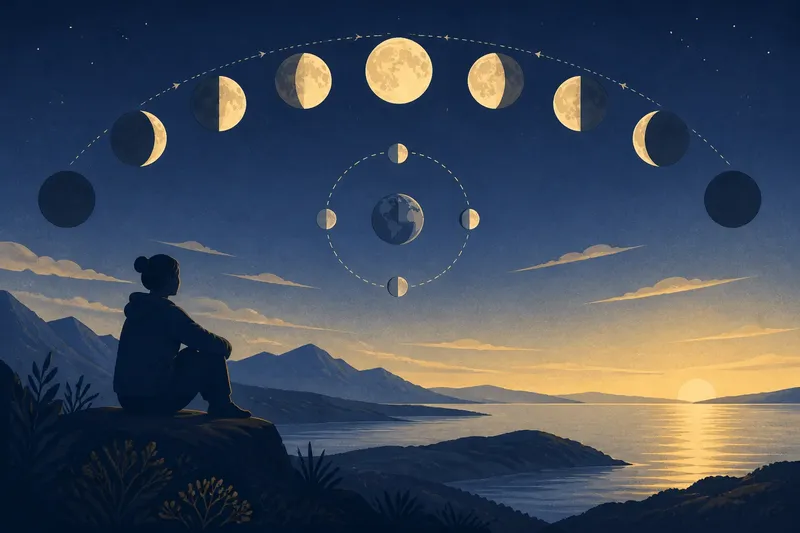
The Moon’s phases are easiest to understand when you stop asking what shape the Moon has become. The Moon’s phases are a lesson in viewpoint: sunlight always illuminates half of the lunar globe, while our changing position relative to the Moon and Sun determines how much of that half we can see.
That simple arrangement produces the crescent, quarter, gibbous and full Moon. Each phase is a different view of the boundary between day and night on the Moon, not a new shape or a shadow cast by Earth. The numbered points below follow that shifting view from one familiar phase to the next.
1. What stays lit as the Moon orbits?
Sunlight arrives from one direction and lights the hemisphere facing the Sun. The opposite hemisphere is in lunar night. As the Moon travels around Earth, the Sun-facing half remains the sunlit half, but its orientation relative to us changes.
It helps to imagine a ball held in a room with one lamp. The lamp lights one side of the ball. Walk around the ball while keeping your attention on it, and the visible boundary between its bright and dark sides shifts across your view. The ball itself has not changed; your angle has.
The Moon is far more distant and the Sun’s light is effectively parallel across it, but the same geometry applies. From Earth, we see a changing fraction of the Moon’s illuminated hemisphere. The bright portion may look curved, straight-edged, or almost complete, depending on the positions of the three bodies.
Keep the lamp, ball and observer in mind: Sun, Moon and Earth.
2. Why does a new Moon look absent?
At new Moon, the Moon lies roughly between Earth and the Sun. Its sunlit hemisphere faces away from us, so the side turned toward Earth is mostly dark. The Moon is still in the sky, but its unlit face is difficult to distinguish against the bright daytime sky, and its narrow edge-on appearance leaves little illumination visible from our viewpoint.
“New” describes a phase, not a disappearance. The Moon continues along its orbit, and a small portion of the sunlit hemisphere soon becomes visible as a waxing crescent. Waxing means that the visible lit portion is increasing from night to night.
The alignment is not exact at every new Moon. The Moon’s orbit is tilted relative to Earth’s path around the Sun, so it usually passes a little above or below the Sun as seen from Earth. When the alignment is close enough, a solar eclipse can occur; that is a special event, not the cause of the ordinary new-Moon phase.
3. What makes a crescent grow?
After new Moon, the Moon moves onward around Earth. A slim arc of its sunlit side becomes visible at dusk or in the early evening. Over successive evenings, the lit portion grows into a broader crescent. The boundary between the bright part and the dark part is called the terminator: it marks lunar sunrise or sunset.
The crescent’s orientation depends on where you are and where the Moon sits in the sky. Near the horizon it may appear like a tilted bowl or a narrow hook; higher up, it can seem to stand more upright. Those visual changes come from the viewing angle, not from the Moon rotating its bright side toward us in some special way.
In a clear sky, the dark portion can sometimes be faintly visible beside the crescent. This is earthshine: sunlight reflected from Earth reaches the Moon’s night side and then reflects back toward us. It is a useful reminder that “dark” means not directly lit by the Sun, rather than completely invisible under every condition.
4. Why is the first quarter called a quarter?
At first quarter, the Moon has completed about a quarter of its orbit around Earth since new Moon. From our perspective, roughly half of the visible lunar disk is illuminated. The name refers to the Moon’s progress around its orbit, not to the amount of the disk that appears lit.
This phase often looks like a half-circle, with a nearly straight terminator dividing light from darkness. The illuminated side points generally toward the Sun’s direction, though perspective and the Moon’s position in the sky can make that relationship feel less obvious than a diagram suggests.
There is no sudden switch from crescent to half. The bright region expands continuously as the angle between the Sun, Moon and Earth changes. “First quarter” is a convenient marker on that gradual cycle, much like a clearly named bend on a curved path.
5. How does a gibbous Moon become full?
After first quarter, more than half of the visible disk is illuminated. This is the waxing gibbous phase. The terminator retreats toward the Moon’s edge in our view, leaving a bright, almost-round disk with a dark margin.
At full Moon, Earth is roughly between the Sun and Moon. We see nearly all of the lunar hemisphere facing us, and that hemisphere is also lit by the Sun. The Moon appears round, though the alignment is usually not exact. If Earth’s shadow falls across the Moon, the result is a lunar eclipse; ordinary full Moons do not sit inside that shadow.
Say you notice the Moon rising while the Sun is setting. The Moon is near the opposite side of the sky from the Sun, so the hemisphere facing Earth is broadly sunlit and the disk looks full or nearly full. As the Moon continues around its orbit, the illuminated portion we see will begin to shrink.
6. Why does the light seem to shrink after full?
After full Moon, the visible lit portion decreases, a process called waning. The Moon passes from waning gibbous through third quarter and into a waning crescent before the cycle returns to new Moon. The same half of the Moon remains sunlit; we are seeing less of that half from Earth.
Third quarter is the counterpart to first quarter. Again, about half the visible disk is bright, but the Moon has traveled farther along its orbit, and the illuminated side is on the opposite side of the disk from the first-quarter view. In many places, this phase is most noticeable late at night or in the morning.
The words waxing and waning describe what happens to the visible illuminated area, not the Moon’s distance from Earth or the strength of sunlight reaching it. A waning crescent can look delicate, but the light on its narrow arc is direct sunlight, just as it is on a full Moon.
7. What questions help you read the phases?
Does Earth’s shadow cause the phases?
No. The ordinary phases come from our changing view of the Moon’s sunlit half. Earth’s shadow reaches the Moon only during a lunar eclipse, when the alignment is unusually close.
Why can I sometimes see the Moon during the day?
The Moon is often above the horizon while the Sun is up. Its visible lit portion and position in the sky determine how easy it is to spot, while the bright daytime background can make a thin crescent harder to pick out.
Why does the Moon’s phase look different in a photograph?
A photograph may be rotated, cropped, or taken from a different latitude, changing the crescent’s apparent tilt. The illuminated fraction still follows the same Sun-Moon-Earth geometry.
Does the Moon rotate while it goes through its phases?
Yes. The Moon rotates as it orbits Earth, and its rotation keeps nearly the same lunar face turned toward us over time. That rotation is separate from the changing illumination that creates the phases.
8. How can you use viewpoint to read the sky?
Begin by locating the Sun’s direction, even if it has already set. A waxing crescent is generally found near the Sun in the evening sky; a waning crescent appears near the Sun’s direction before sunrise. A full Moon is opposite the Sun in the sky, while quarter phases sit roughly at a right angle to it.
Then look at the terminator. Its curve shows the boundary between lunar day and night, and its position tells you how much of the visible face is illuminated. The curve is not a shadow line creeping across a stationary disk as seen from Earth; it is the edge of the sunlit hemisphere from our changing vantage point.
For a simple observation, note the phase and time of day, then check the Moon again on a later evening or morning. Record whether the lit area is growing or shrinking and where the Moon sits relative to the horizon. The pattern is easier to grasp when the sky is treated as a spatial arrangement rather than a row of isolated lunar portraits.
The Moon’s phases make sense when you track the sunlit half from changing viewpoints. Once that idea settles in, a crescent is no longer a fragment of a changing object; it is a precise view of sunlight, orbit and position meeting in the sky.