Binoculars or a Small Telescope for Looking at the Moon?
Choose binoculars or a small telescope for looking at the Moon by weighing field of view, steadiness, setup, and the kind of lunar detail you want to study.
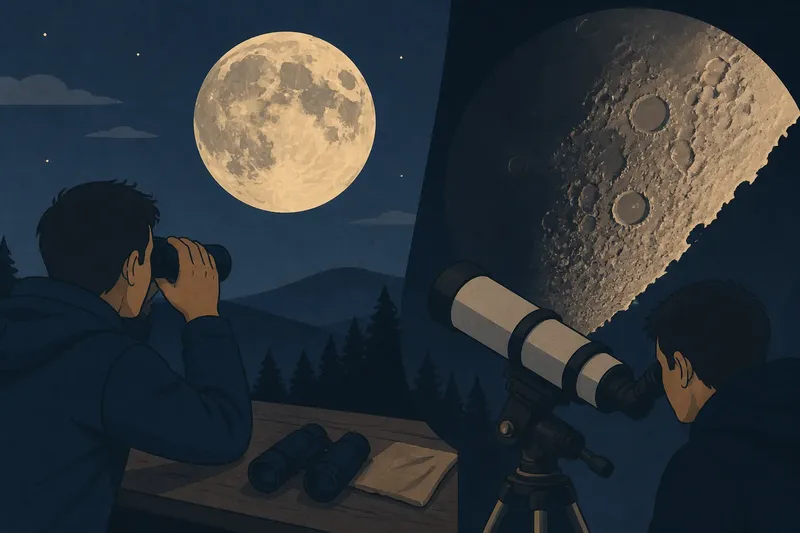
Binoculars or a small telescope for looking at the Moon? The choice changes the shape of the view: a wide sweep that keeps the lunar disk together, or a narrower look that invites closer inspection of one area. It also changes how you aim, steady, and return to a feature.
What kind of lunar view do you want?
Binoculars keep more of the Moon in view at once. The curved edge, dark maria, and bright highlands sit together, so their arrangement reads as a composition rather than a set of isolated marks.
A small telescope narrows attention. Depending on its eyepiece and optical design, it can show a smaller region at higher magnification, making crater rims, overlapping circles, and long shadows more prominent. The disk may not fit comfortably in the view, so observation becomes a slow tour rather than a single glance.
Choose binoculars when the relationships among features matter most. Choose a telescope when you would rather examine a specific formation and do not mind moving across the surface in sections.
How much handling feels comfortable?
Binoculars are quick to bring to the eyes and easy to point. Their two-eye view can feel natural, but holding them steady takes effort. A small tremor shifts the lunar edge and can make fine detail seem to swim.
A telescope asks for more setup. It needs a stable support, such as a suitable tripod or small mount, and its narrower field makes aiming more deliberate. Once positioned, the support carries the instrument’s weight and reduces hand movement that might distract from close viewing.
Imagine you have a clear evening, a pair of binoculars, and only a few minutes before heading indoors. You raise them and find the Moon quickly, but their movement makes the edge waver. If you then set a small telescope on a stable mount and aim at a crater near the terminator—the boundary between lunar day and night—the view should remain steadier for examining that one area, at the cost of extra setup and a narrower field.
A useful distinction: binoculars simplify the start; a mounted telescope supports a longer look.
Does magnification settle the choice?
Not by itself. Higher magnification makes a smaller portion of the Moon fill the view, but it also makes motion more obvious and finding a target harder. A large-looking image is not automatically a more satisfying one if it is difficult to hold steady or orient.
Binoculars usually make locating and framing the Moon simpler, while a telescope offers more room to adjust the apparent closeness by changing eyepieces. The practical question is whether you can keep a feature in view and enjoy examining it. A stable, moderate view can be more useful than magnification pursued for its own sake.
Check the mount and eyepiece instructions for the specific instrument; compatibility varies.
Which instrument fits your situation?
- If you want the lunar disk and its broad pattern together, then choose binoculars; if you would rather isolate a smaller region, then choose a telescope.
- If you want to begin with little setup, then choose binoculars; if you are willing to position a support before observing, then consider a telescope.
- If holding an instrument still is difficult, then brace binoculars against a firm surface or use a suitable support; if you prefer the support to carry the instrument, then choose a telescope on a stable mount.
- If you want to study a crater rim or shadow boundary closely, then choose a telescope; if you want that feature in relation to nearby lunar patterns, then choose binoculars.
- If several people will take turns looking, then choose the instrument that can be aimed and handed over without losing the target; if a telescope’s mount makes that awkward, then binoculars may be simpler.
- If storage and carrying ease matter most, then compare the complete instrument and support you would need; if the telescope’s mount makes the setup cumbersome, then favor binoculars, while a compact supported arrangement may still suit you.
Use the instrument’s labeling and manufacturer instructions when choosing a mount, eyepiece, or support method.
What should you consider before choosing?
Can binoculars show lunar craters?
Yes. Binoculars can reveal broad surface patterns and some larger crater features in a steady view. Their strength is placing those details within a wider scene, not making every small formation prominent.
Is a small telescope better for close lunar detail?
It can be, if you enjoy a narrower view and have a stable support. A telescope makes a smaller area easier to inspect, but requires more deliberate aiming and may not show the whole disk at once.
Are binoculars easier to use than a telescope?
They are generally quicker to point and need less setup. Holding them steady can be tiring, while a telescope’s mount takes preparation but supports the instrument once it is in place.
Can I use both for different kinds of viewing?
Yes. Binoculars provide a broad view of the lunar arrangement, while a telescope can bring one area closer. They suit different ways of looking rather than acting as simple substitutes.
Which one is the better first choice?
If you prefer the whole lunar disk and its large-scale arrangement, binoculars are a sensible first choice. If you are drawn to close-looking—following a crater rim, comparing nearby textures, or watching shadows define relief—a small telescope is more fitting, provided you are willing to support and aim it carefully.
For choosing binoculars or a small telescope for looking at the Moon, let your preferred pace decide: a broad view for an immediate impression, or a narrower view for patient inspection. Consider the complete setup, not just the optical tube or binoculars; a support that is awkward to handle can change how readily you return to the view.